Are Mug Warmers Worth It?
For most desk workers and slow drinkers, yes. A basic mug warmer runs $9 to $30, draws minimal electricity, and keeps coffee or tea at a drinkable temperature for hours. The main caveat is that warmers maintain temperature rather than reheat, so you need to place a hot drink on one right away, not a cold cup.

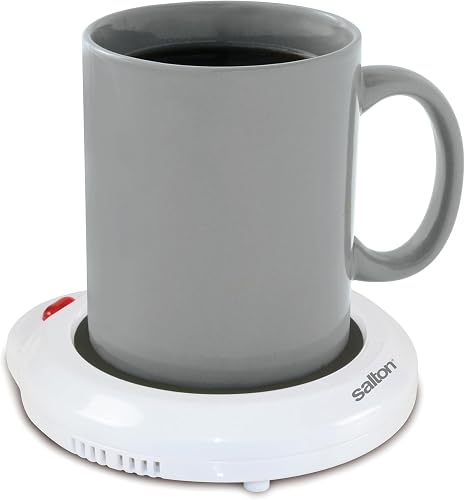

What a Mug Warmer Actually Does
A mug warmer is a small heated plate that sits on your desk and keeps a filled cup at a steady temperature. It does not brew or reheat from cold. Wattage in this category ranges widely, from 17 W on the Evelots 2803 up to 650 W on the Paris Hilton PH11283, and that gap matters because higher wattage means a warmer plate surface and a better ability to fight heat loss in thicker mugs. Most office-style warmers fall between 17 W and 200 W, which is enough to maintain a drink that started hot. Think of it as a passive hold function, not a microwave substitute.
Who Gets Real Value from One
Mug warmers make the most sense for people who pour a full cup and then get pulled into calls, emails, or tasks before they can finish it. Slow drinkers, writers, remote workers, and anyone who brews in a standard drip machine but tends to forget their cup all benefit. They also work well for tea drinkers who steep a pot and sip over an hour. If you drain your cup in five minutes, a warmer adds nothing. And if you prefer iced coffee, it is obviously not for you.
The Cost and Energy Math
Entry-level warmers like the Evelots 2803 at $8.99 draw only 17 W. Running one for eight hours a day costs roughly a penny or two in electricity, depending on your local rate. Even the 200 W Salton SMW12 at $14.97 costs less than a quarter per day at continuous use. On the product side, the price spread in this category runs from $9 to about $60, and the higher prices tend to reflect temperature controls or a second warming slot rather than better heat-holding. For most buyers, a warmer in the $9 to $30 range does the job without compromise.
Wattage, Size, and Mug Compatibility
Plate size and wattage together determine how well a warmer works with your specific mug. The Salton SMW12 measures roughly 6.8 by 10.8 inches and outputs 200 W, making it one of the larger, higher-output options in this lineup. The Cosori CO294-CW is much smaller at 5.39 by 4.29 inches and runs at just 24 W, which suits a standard ceramic mug but may struggle with a wide tumbler. Stainless steel tumblers and double-wall cups are the hardest to warm because the insulation works against the plate. Thin ceramic and glass mugs respond the fastest. Always confirm your mug's base diameter fits within the plate before buying.
What the Ratings Tell You
Across seven products in this category, ratings cluster between 4.0 and 4.4 stars. The Salton SMW12 has accumulated over 5,500 reviews at 4.3 stars, and the Cosori CO294-CW has over 4,600 reviews at 4.2 stars. Those are large, stable sample sizes that suggest consistent satisfaction. The Evelots 2803 earns 4.4 stars across 1,600 ratings at just $8.99, which is unusually strong performance for the lowest-priced option in the set. Newer or more expensive options like the Kepwam TCM2 at $59.98 sit at 4.0 stars with 1,500 reviews, suggesting the premium does not necessarily translate to better satisfaction. High star counts on cheap warmers confirm that basic units work reliably for most buyers.
When a Mug Warmer Is Not the Answer
A warmer will not save a cup that has already gone cold. If you routinely reheat drinks, a small countertop milk frother or a quick microwave pass is a better fit. Mug warmers also require a power outlet nearby, which rules out commutes, outdoor tables, and many shared workspace setups. People who move around the office constantly may find a well-insulated travel tumbler more practical than a corded plate. Finally, if you use a French press or pour-over carafe that is too wide for the plate, the warmer will not make contact with enough surface area to do much good.
Common mistakes to avoid
- Placing an already-cold cup on the warmer and expecting it to heat back up. Warmers hold temperature, they do not reheat.
- Buying a high-wattage warmer for a thin ceramic mug. Low-wattage options like 17 to 40 W are plenty for standard ceramics and avoid scorching the base.
- Ignoring plate size. A 5-inch plate under a wide travel tumbler barely contacts the base and provides little warmth.
- Leaving a warmer on unattended with an empty mug. Extended dry use can damage the plate coating on some models over time.
- Assuming a pricier unit keeps drinks hotter. In this category, price often reflects extra slots or temperature controls rather than better heat output.
- Not checking voltage. Most warmers in this set run at 110 to 120 V US standard, but verify before purchasing if you plan to use one abroad.
Frequently asked questions
Can a mug warmer reheat cold coffee?
No. Mug warmers are designed to maintain the temperature of a hot drink, not raise the temperature of a cold one. If your coffee has gone cold, a brief microwave pass is faster and more effective before you set it back on the warmer.
Are mug warmers safe to leave on all day?
Most are built for continuous desk use, and the low-wattage models in this category draw between 17 W and 77 W, which generates only moderate surface heat. That said, always follow the manufacturer's guidance, keep the plate clean and free of spills, and avoid running any warmer with an empty mug for extended periods.
What wattage do I need for a stainless steel tumbler?
Stainless steel tumblers, especially double-wall insulated ones, resist heat transfer by design. You generally need at least 77 W to see a noticeable effect, and even then results vary. A 200 W warmer like the Salton SMW12 gives you the best chance, though a single-wall ceramic mug will always respond more readily.
Will a mug warmer work with any mug?
It works with most ceramic, glass, and single-wall mugs whose base fits within the plate. Wide travel tumblers, very large carafes, and heavily insulated double-wall cups often do not make good contact with the plate, which limits how much heat transfers.
Who should I contact with questions about this guide?
You can reach the TastefulCoffee editorial team at [email protected].